Leia a review MoustachesToys do Volumio Rivo em português
I admit it without hesitation: when I asked the Portuguese distributor for a Volumio Rivo, it wasn’t out of casual curiosity. It was to answer the question that had been itching in my mind ever since I reviewed its sibling, the Volumio Primo: can a streamer at this price really challenge machines three, four, even five times more expensive? For me, the doubt was impossible to ignore.
The truth is simple: there is only one laboratory where promises die and reality begins: your own listening room. That’s how it is for me, and how it should be for anyone. In that space, there is no marketing, no hype, just a pair of ears, yours.
And so the inevitable question emerged almost immediately: “So, Vítor… did the Rivo stay, or not?”
Those who have followed my journey probably already know the answer. Everyone else will have to walk with me until the end. Because the answer is simple, but the path towards it is far more interesting.
First Impressions
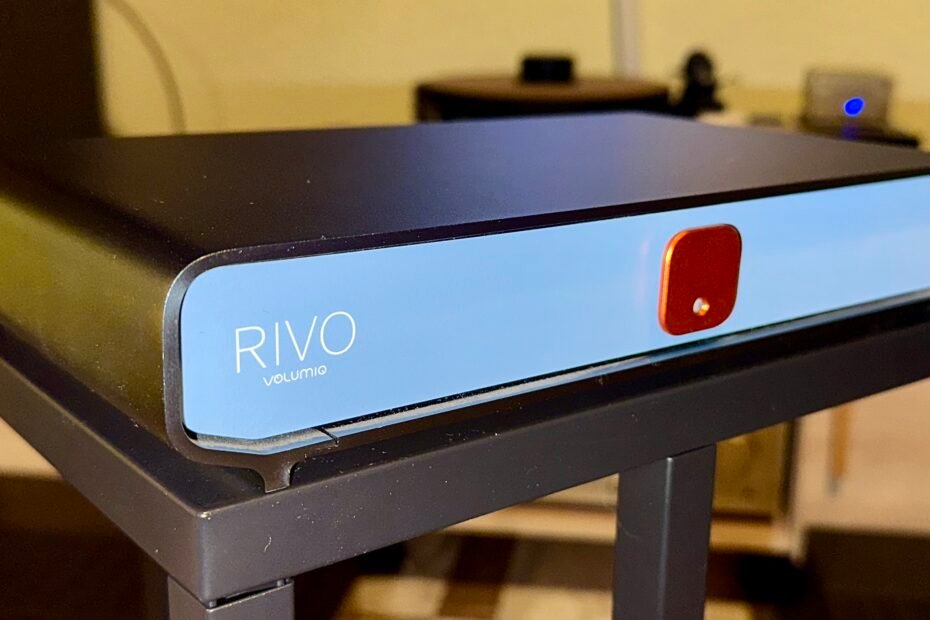
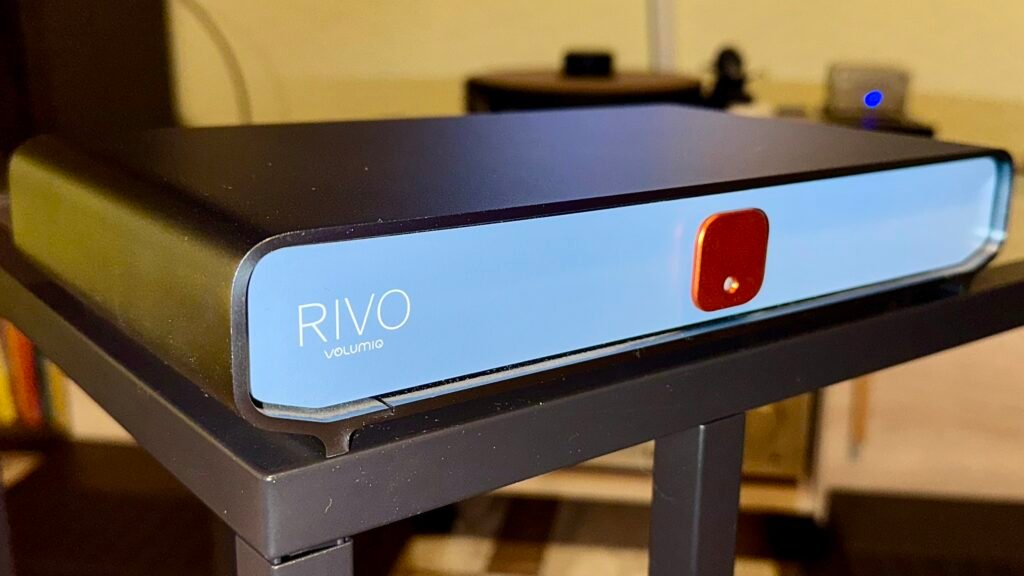
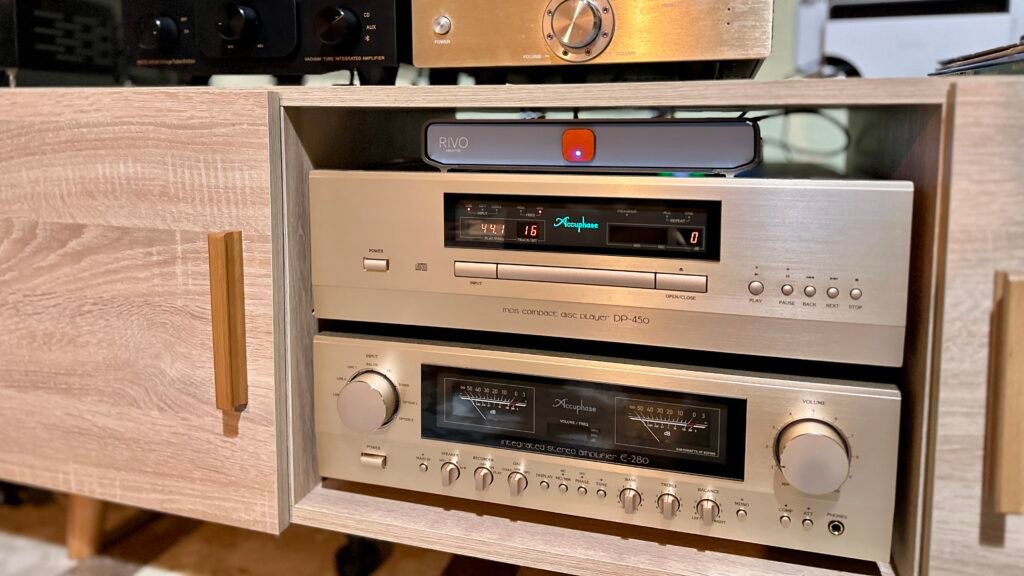
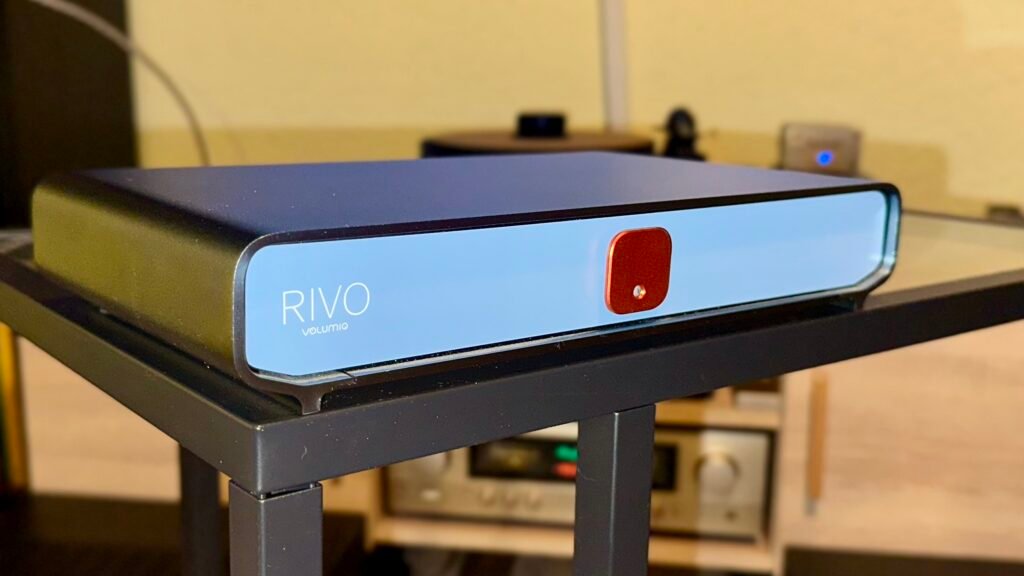
Some streamers walk into the listening room as if stepping onto a red carpet; the Rivo prefers discretion and purpose. Its understated chassis seems to say: “I’m not here to shine. I’m here to work.”
A single front button with a colour-changing LED provides the only visual accent.
Like the Primo, the Rivo can be connected to a monitor via HDMI, and operated with keyboard and mouse, a quiet reminder that behind every streamer lies a carefully stripped-down computer tuned for one task: making music purer.
Any serious assessment of a streamer inevitably divides into two fronts: Function and Sound.
Digital Connections & I/O

On the rear panel you’ll find exactly what matters, no more, no less:
- Ethernet RJ45 input (with Wi-Fi available if needed)
- USB and MicroSD for local sources
- Digital outputs: USB, AES/EBU, and coaxial
- 5V/3A external DC power input
The choice of external power makes clear room for upgrades: you can elevate the Rivo further with a proper linear power supply. I haven’t tested one yet, but that also means you have a reason to come back to MoustachesToys in the near future, right?
Analog outputs? None.
This is a pure transport, leaving D/A conversion entirely to your DAC of choice.
Even the discreet on/off switch matches the machine’s philosophy: do what’s essential, don’t draw attention.
Interface & User Experience

If there’s one word to describe the Rivo in daily use, it’s stability. It worked flawlessly with:
- Volumio app
- Roon
- AirPlay
- Qobuz Connect, where, I admit, it has lived permanently since the day the feature was launched
I explored the Volumio interface in depth in my Primo review, so you can check the link.
What matters is this: the Rivo distinguishes itself not by how you control it, but by how it delivers digital signal to the DAC.
And now, we reach the question everyone is waiting for:
What does the Volumio Rivo sound like?
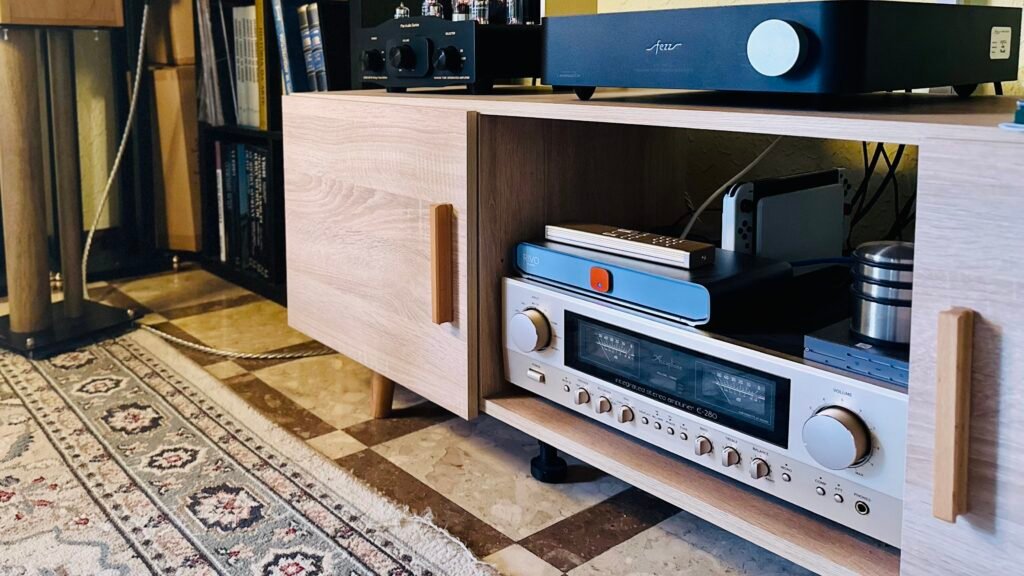
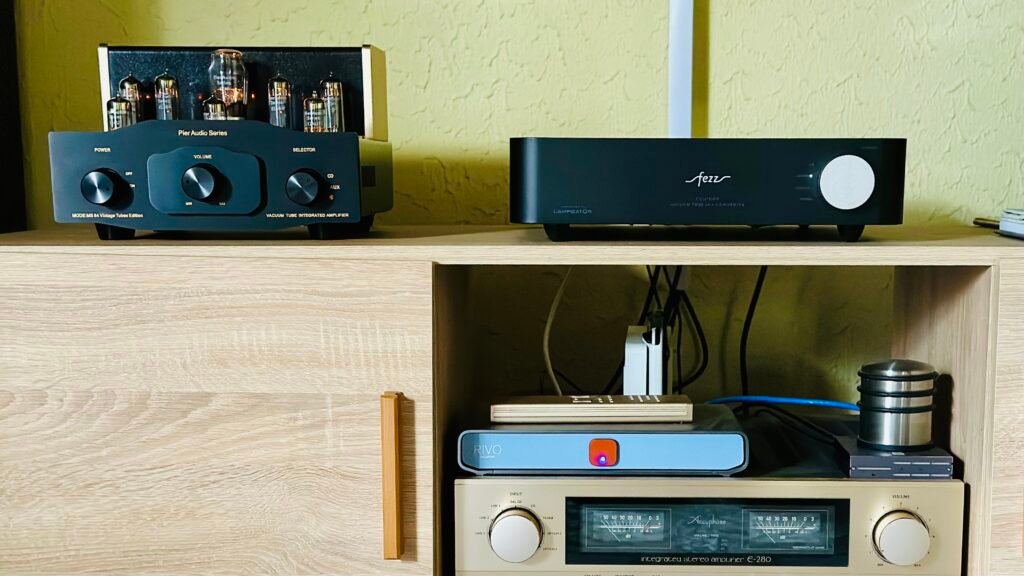
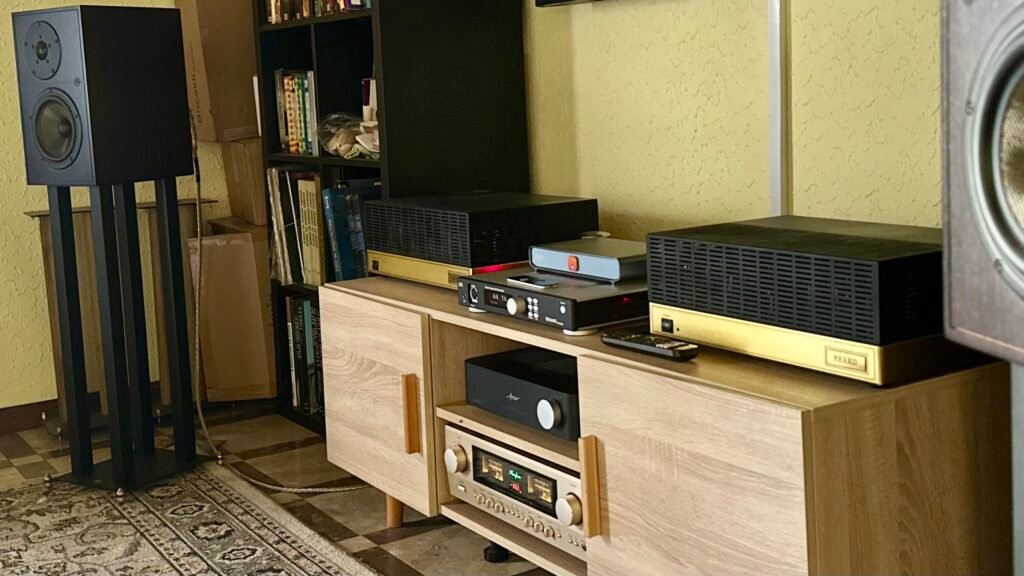
Over nearly a year, the Rivo played with everything I connected to it: Revival Atalante 3, the omnidirectional Duevel trio, my resident Accuphase E-280, the Lyric Ti 100 single-ended tube amp, Beard M70 MkII monoblocks, the Fezz Equinox DAC, Lab12 Reference 1 DAC, Denafrips Pontus 15th Anniversary, TEAC UD-701N, and even the internal DAC of the Accuphase DP-450.
This wide cast of partners helped me distill what the Rivo truly is.
The Polished Lens
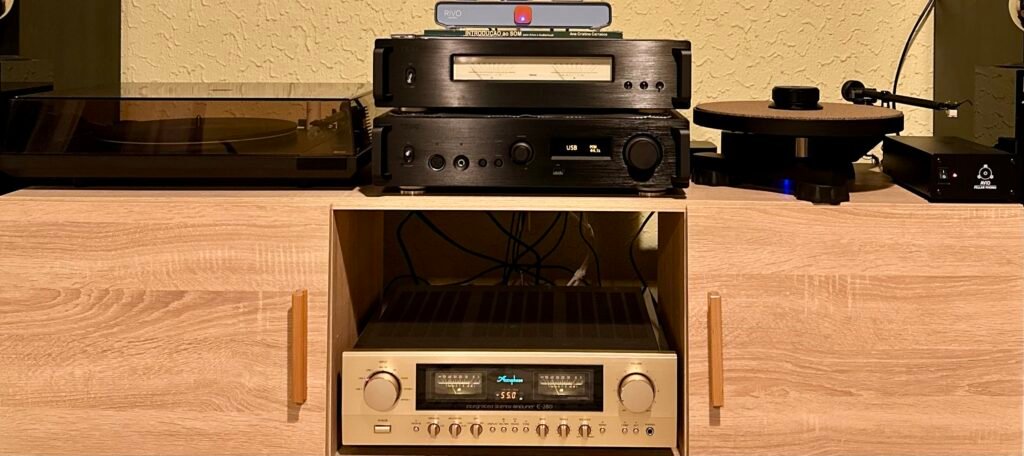
When I first paired the Rivo with my resident DAC, the Equinox, the sensation was immediate: this transport doesn’t try to impose its own image, It illuminates the music that’s already there.
It’s like wiping a window you thought was clean: suddenly there is more air, more depth, more intention in every sound that enters the room. Music gains space between notes — the very space where emotion lives.
USB — The Path Where the Rivo Truly Dances

Through USB, the Rivo shows its full potential.
The sound becomes coherent, rhythmically confident, and spatially open. Like a room lit by wide windows:
- Bass pulses with purpose and definition.
- Voices materialize like sculptures bathed in side light.
- Instruments find their place with the discipline of an orchestra.
Across every DAC I tested (Equinox, Pontus 15th, Lab12, and the DACs inside the UD-701N and DP-450), the Rivo preserved its core personality:
neutrality and inner silence.
No colouration. No dramatization.
Pure revelation.
SPDIF — Competent, But…
The coaxial output works competently, though not with the quasi-cinematic presence that USB delivers, at least not with the cable I had on hand.
It’s like watching the same film on a CRT screen: the story is there, but without the same shadow detail or spatial texture. If you want the Rivo at its best, the choice is clear: USB.
(The AES/EBU output I did not test myself, but during this Rivo’s visit to a friend’s system, that connection convinced him enough to buy one immediately.)
Space, Imaging & Depth — The Architecture of Music
The Rivo’s soundstage is surprisingly mature for its price point. The sensation is architectural. Japanese architecture, specifically: clear lines, intentional emptiness, silence used as structure.
Three-dimensionality is firm, instrument outlines precise (sharper or smoother depending on the DAC). There is air between sources. The music doesn’t sound “digital”, as is the current fashion to complain, but organic, like film photography rather than digital capture.
Even in dense passages, nothing clashes, nothing dissolves.
Music isn’t a wall of sound; it’s a Michelangelo sculpture, dramatic, realistic, veins included.
Dynamics & Energy — Effortless Movement
Despite that sculptural presence, the Rivo doesn’t impress through force, but through the delicacy of continuous energy. Microdynamics: the blink-between-notes, the slight breath before a vocal line, appear clearly and naturally. Transients are quick, elegant, clean. There is physical presence, but never a forced one.
Texture & Musical Content — The Inner Painting
If I had to choose one thread running through all its performances, it would be coherence.
Everything fits: textures, detail, silence.
It’s like looking at a photographic print developed in a darkroom: colours natural, nothing exaggerated.
- Average recordings are simply average.
- Good recordings bloom.
- Great recordings… reveal everything.
Qobuz Connect — A State of Grace
With Qobuz Connect, the Rivo reaches a state of grace. More nuance, more emotional density, more harmonic naturalness. The stage stabilizes, like a camera finally locked on a tripod. From the day this feature became available, I stopped using the Rivo any other way.
And yes, I’m still curious to use it for ripping my CD collection and listening with streaming convenience. One day, when time allows.
Power Supply — The System’s Breath
The included power brick could be from a smartphone, and it is the Rivo’s most obvious bottleneck.
With a better power supply, the promise is clear: the Rivo wakes up even further.
It’s obvious to me that the Rivo was designed to scale. I’m already salivating at the idea of hearing it with a proper linear PSU. Consider this both a promise and a challenge to the distributor. We’ll revisit this topic soon.
Contextual Reflection
Some equipment makes us think of machines; the Rivo made me think of architecture.
Perhaps because of how it organizes space, perhaps because of the internal silence that supports every note.
There is something Japanese about it: not superficial minimalism, but the idea that emptiness is also material.
Maybe that’s why, in longer sessions, I found myself remembering the first hi-fi system that ever moved me.
It wasn’t expensive. It wasn’t modern. But it had this same rare quality: the ability to step back so the music could take the whole room.
The Rivo shares that DNA, a rarity in our time.
Pros & Cons
After almost a year living with it, across multiple DACs, amps, and speakers, the conclusion is clear:
the Volumio Rivo doesn’t want to be the protagonist. It wants to be the stage light.
It respects the signal. Gives it room. Gives it air. Gives it coherence. No colouration. No invention. Just revelation.
And for its price, it is one of those rare machines that seem to cross performance levels normally reserved for far more expensive gear. The better the system around it, the more the Rivo reveals itself as a silent ally. One you miss more when it leaves than when it arrives.
Pros
- Surprisingly refined sound quality for the price
- Deep, three-dimensional soundstage
- Neutrality: no colouring, no dramatizing, nothing hidden
- Excellent USB output with great timing and musicality
- Perfect integration with Qobuz Connect
- Clear potential to scale with a high-quality linear PSU
- Discreet but solid construction
- Stable, easy-to-use interface
Cons
- Stock power supply limits its true potential
- Coaxial output competent but lacking magic (with the cable I used)
- Lack of display may deter some users
So… did the Rivo stay or go?
Even for those who haven’t followed me through 2025, the answer is now obvious.
Yes, the Rivo stayed.
It stayed, and it is now the reference digital transport in my system.
Specifications

Pingback: Eyes Eat First: HiFi Rose RS130 + RD160 - MoustachesToys Review - MoustachesToys | High-End Audio Reviews & Experiences
Pingback: Então,… o Volumio Rivo ficou, ou não? - MoustachesToys | High-End Audio Reviews & Experiences