
A review do Marantz M1 em português
Marantz M1 Streaming Integrated Amplifier | MoustachesToys Review
What It Is (and What It Isn’t)
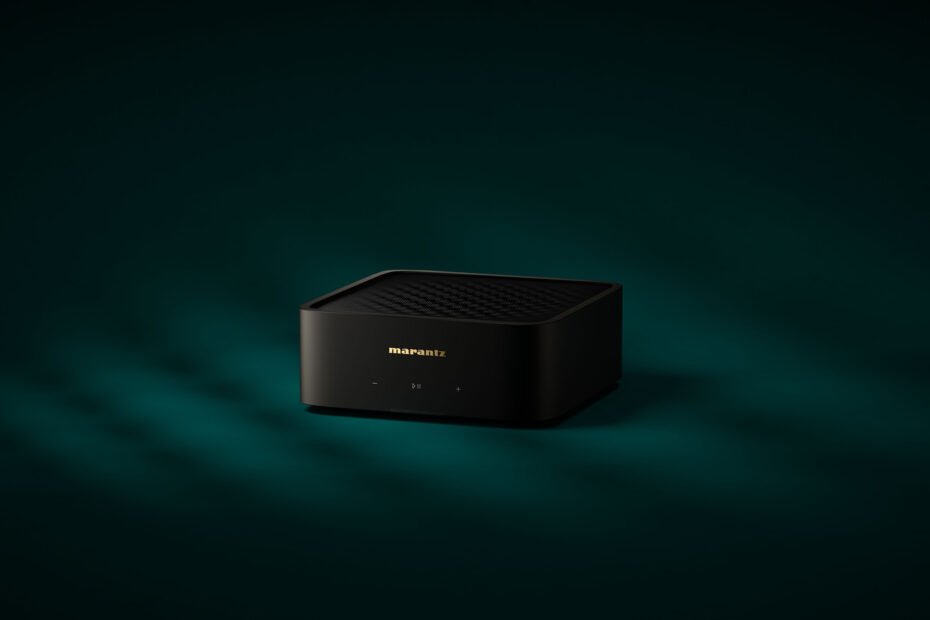
The Marantz M1 is an all‑in‑one integrated streaming amplifier designed for listeners who want a compact, minimalist and modern system without giving up genuine sound quality. It combines a network streamer, DAC and Class D amplification into a single chassis — clearly aimed at the lifestyle audio segment, and tuned with Marantz’s sonic DNA.
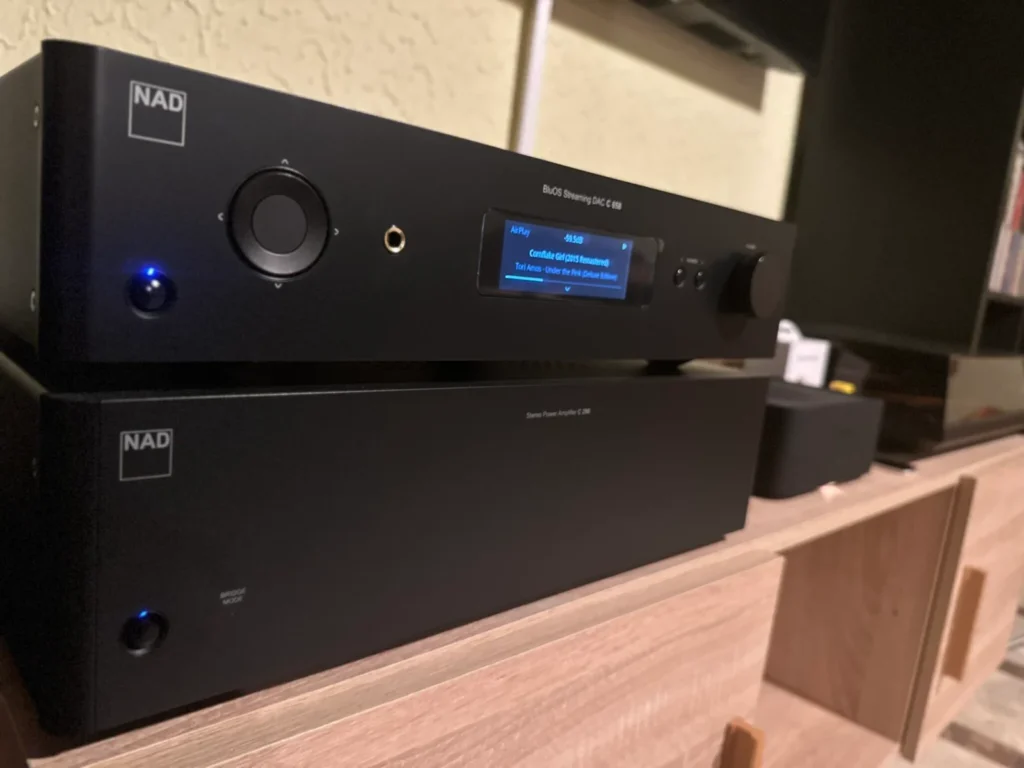
It does not try to be a separates-based hi‑fi system, nor does it compete directly with high‑end dedicated amplification. The M1 exists to solve a very concrete problem: how to get real stereo sound, with minimal space, minimal cabling and zero complexity.
That goal — for better or worse — defines the entire experience.
What the M1 Was Designed For
What It Aims to Be
A genuinely integrated solution for real rooms. Urban apartments. Shared shelves. People who value square meters just as much as the audiophile tribe values transients and soundstage depth. A product that removes friction without sacrificing audible quality.
What It Clearly Is Not
It is not a direct competitor to dedicated hi‑fi separates. It is not for tweakers. It is not for those who measure harmonic distortion before breakfast. This is lifestyle audio with sonic dignity, not purist hi‑fi in minimalist disguise.
Who It Is For
- Listeners moving from earbuds or soundbars to real speakers
- Those who want clearly audible quality without becoming militant audiophiles
- Anyone who wants a system that disappears into daily life
- People willing to trade the last 10–15% of absolute performance for 100% simplicity
Lifestyle First
One Box Instead of Three
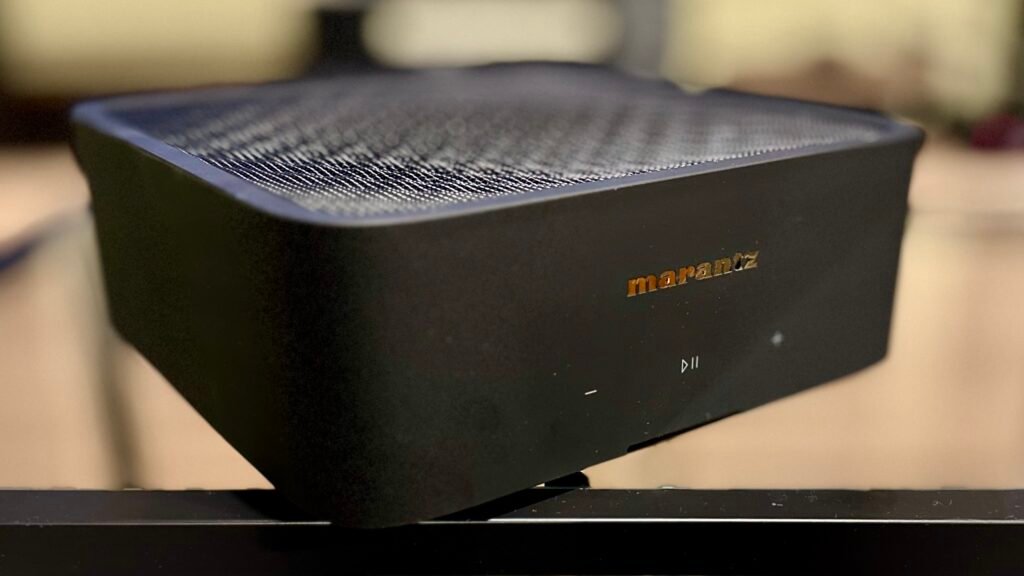
The M1 condenses streamer, DAC and amplification into a compact, discreet chassis. Where you would normally need three or four boxes, multiple power supplies and a tangle of cables, you now have a single unit — silent and thermally efficient.
This is not merely an aesthetic advantage. It’s structural. It frees space, simplifies daily use and allows a level of domestic integration that separate components rarely achieve.
No‑Drama Setup
Power cable + speaker cables + network (Wi‑Fi or Ethernet) = music.
From unboxing to playback takes minutes, not hours spent reading manuals or agonising over interconnect choices. For the M1’s target audience, this is not a side benefit. It is the product.
Design That Belongs in a Real Living Room
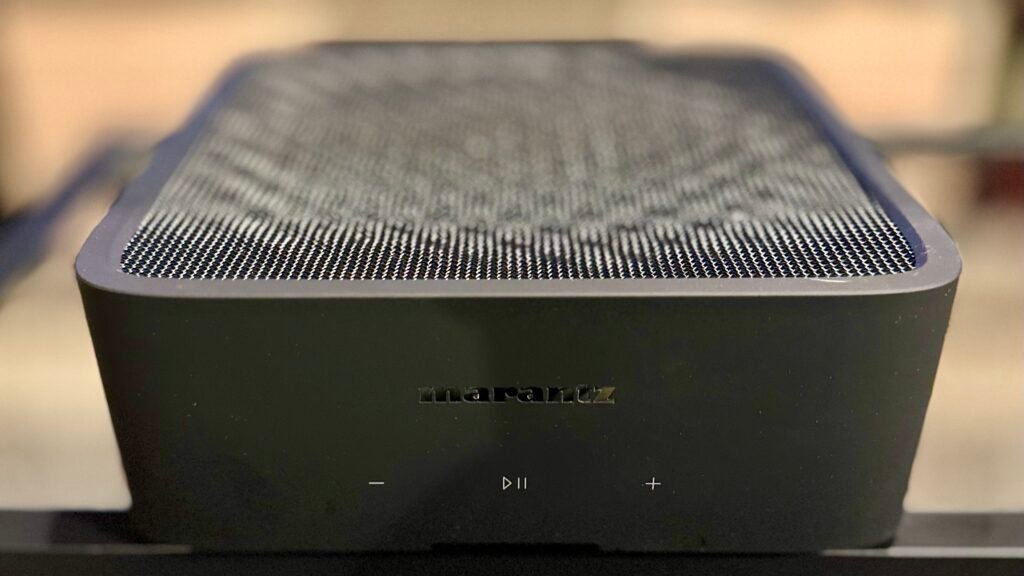
Minimalist, discreet, free of aggressive LEDs. The M1 does not try to dominate the room — it tries to blend in. And it succeeds.
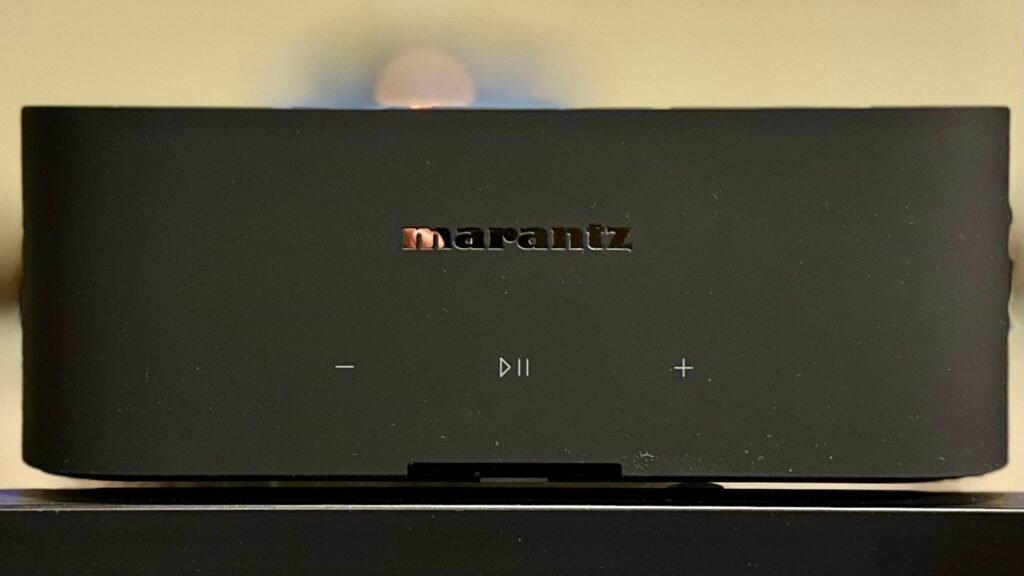
Important note: there is no front display. All visual interaction happens via the HEOS app. For some users this will feel perfectly natural; for others it may be a dealbreaker. The M1 assumes your smartphone is the display — a coherent modern philosophy, though not a universal one.
WAF (Wife Acceptance Factor)? High!
Technical Architecture — Amplifier, DAC and Streaming
Amplification
Class D, rated at 2 × 100 W into 8 Ω. Respectable numbers — but what matters is how they translate in real use.
Forget ultra‑boutique speakers designed for a tiny niche within a niche. Neither the Duevel Planets nor the Azoric Audio Corvo were particularly happy with the M1. By contrast, more approachable designs like the Triangle Borea BR03 posed no problems at all. The Revival Atalante 3, looking down from a higher league, still allowed the M1 to sound more authoritative than its compact form would suggest.
Bass control is solid, composure remains intact at healthy listening levels, and there is no obvious sense of strain in my room (< 25m2).
With more demanding speakers, the limits appear: reduced authority, a narrower soundstage and some dynamic compression. It doesn’t collapse — but it doesn’t perform miracles either. Nor does it pretend to.
DAC & Digital Conversion
Implementation matters more than chip choice, and Marantz has clearly prioritised musicality over clinical analysis.
The presentation is warm, smooth and fluid. It does not impress in the first 30 seconds with hyper‑detail, but it invites medium to long listening sessions. Background noise is low — especially in streaming — and digital hardness is largely absent. Only when unfair comparisons are made against far more expensive systems does the bed start to feel a little short.
Platform & Connectivity
HEOS is functional. Stable. Uninspiring.
It supports Tidal, Qobuz, Spotify Connect, AirPlay 2, and is Roon Ready. The app is not the most elegant on the market, but it rarely gets in the way — which, for a lifestyle product, matters more than beauty.
Clear limitations:
- Only one analogue input
- No headphone output
- Total dependence on the app (using Tidal or Qobuz Connect is recommended if you subscribe)
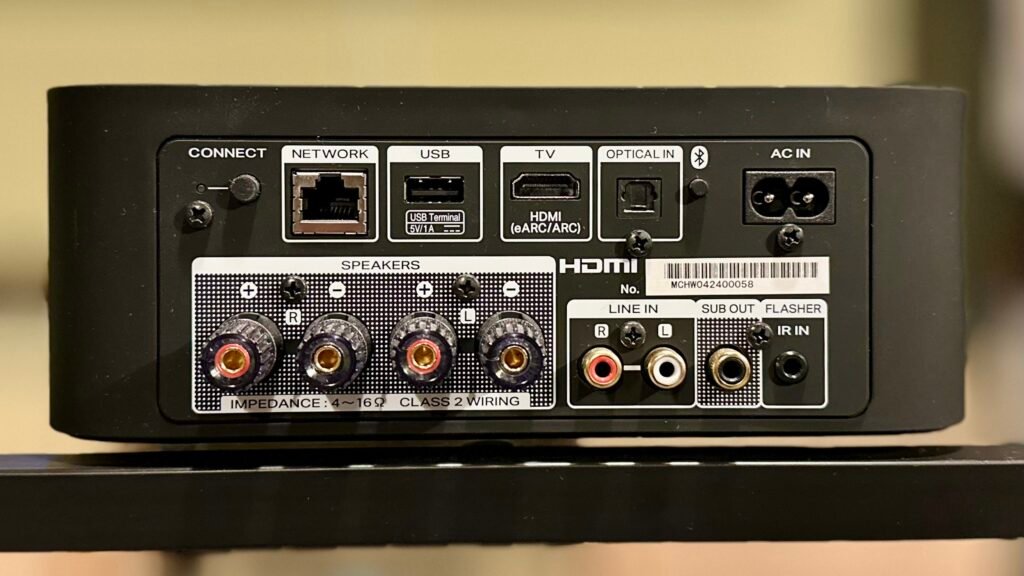
None of this is accidental. It’s a conscious design choice.
The Marantz M1 Sound Signature
The Marantz M1 sounds polite, engaging and musical.
It is not clinically neutral. It leans slightly to the warm side, with pleasant mids, controlled treble and bass that prioritises texture over visceral slam.
Compared to a higher‑league amplifier such as my Accuphase E‑280, there is less tonal density, less spatial depth and less absolute authority. But there is also considerably more money left in your wallet.
And that changes everything.
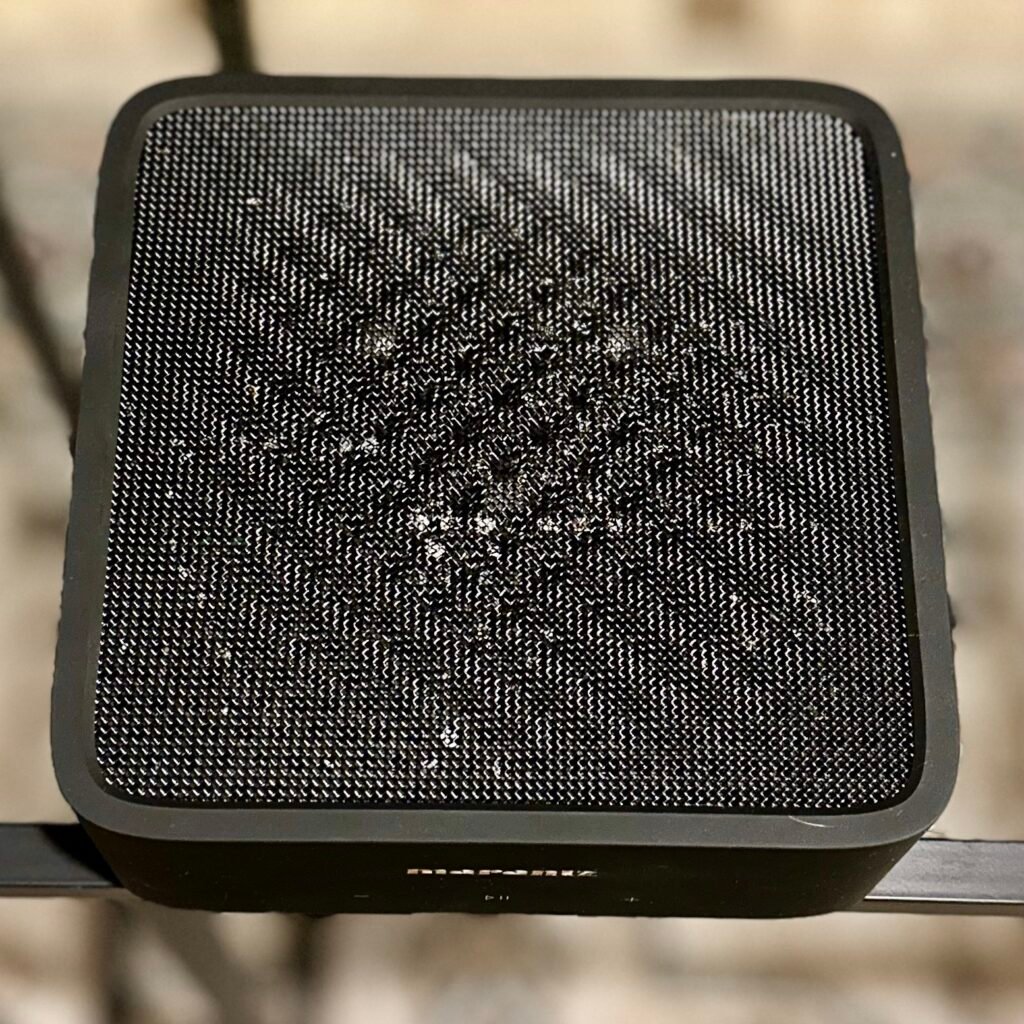
At low to moderate volumes, the M1 is particularly convincing: tonal balance remains intact, nothing thins out, and body is preserved. At higher levels, paired with the Atalante 3, it surprised with its composure.
The highest compliment? It disappears. Not in the way audiophiles usually mean it — but in the sense that it lets you listen to music.
Timbre, Dynamics and Flow
Voices are an unexpected strength. There is enough texture, convincing naturalness and a welcome absence of glare. Male or female, vocals are presented with body and articulation.
Dynamics are honest: quick, articulated and sufficient to keep rhythmic music engaging — rock, jazz, electronic and modern pop included. With highly demanding orchestral music, limits become apparent: slight compression, reduced scale. In context, entirely expected.
Most importantly, the music flows. There is no exaggerated digital stiffness or sense of over‑processing.
Speaker Synergy — Where It Shines (and Where It Doesn’t)
The M1 prefers easy‑to‑drive speakers.
Works very well with:
- Triangle Borea BR03 (excellent synergy)
- Revival Atalante 3 (bring out the best the M1 can offer)
Shows its limits with:
- Speakers designed for more demanding amplification
The Right Question
After a few months of living with it, the question isn’t “what does it do well?”.
It’s this:
Do you feel like listening to music — or fiddling with the system?
With the M1, the answer is almost always the former.
There is no listening fatigue in realistic, extended sessions. No rituals. No urge to constantly optimise. The system becomes invisible — and for a lifestyle product, that is the highest possible praise.
Is It Worth It?
The Marantz M1 is not an amplifier to romanticise. It’s an amplifier to use.
It doesn’t redefine categories. It doesn’t perform miracles. It doesn’t compete with high‑end separates.
But it delivers with intelligence, honesty and genuine sonic competence.
For those who value simplicity without mediocrity, domestic integration without sacrificing music, and a system that quietly disappears into everyday life, the M1 delivers exactly what it promises.
And it delivers it well.

Pingback: MODEL 70 and CD 70: Marantz and the Art of Saying No - MoustachesToys | High-End Audio Reviews & Experiences
Pingback: Marantz M1 — Uma Caixa Única - MoustachesToys | High-End Audio Reviews & Experiences