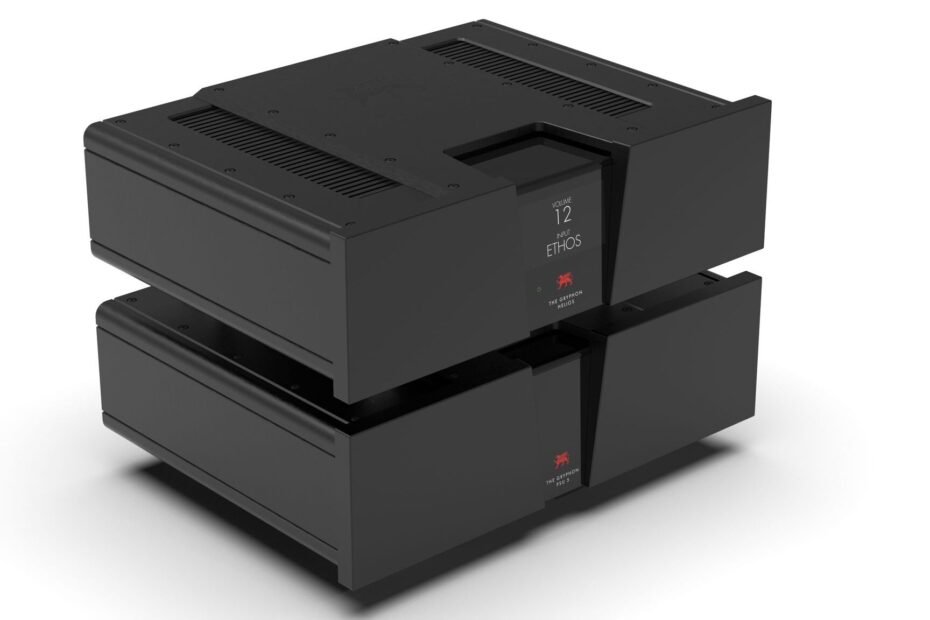
Pandora’s successor arrives at €22,800 (preamp) + €15,800 (PSU), with unprecedented modularity and a new visual language. More than a launch — is it the beginning of a new cycle for Gryphon?
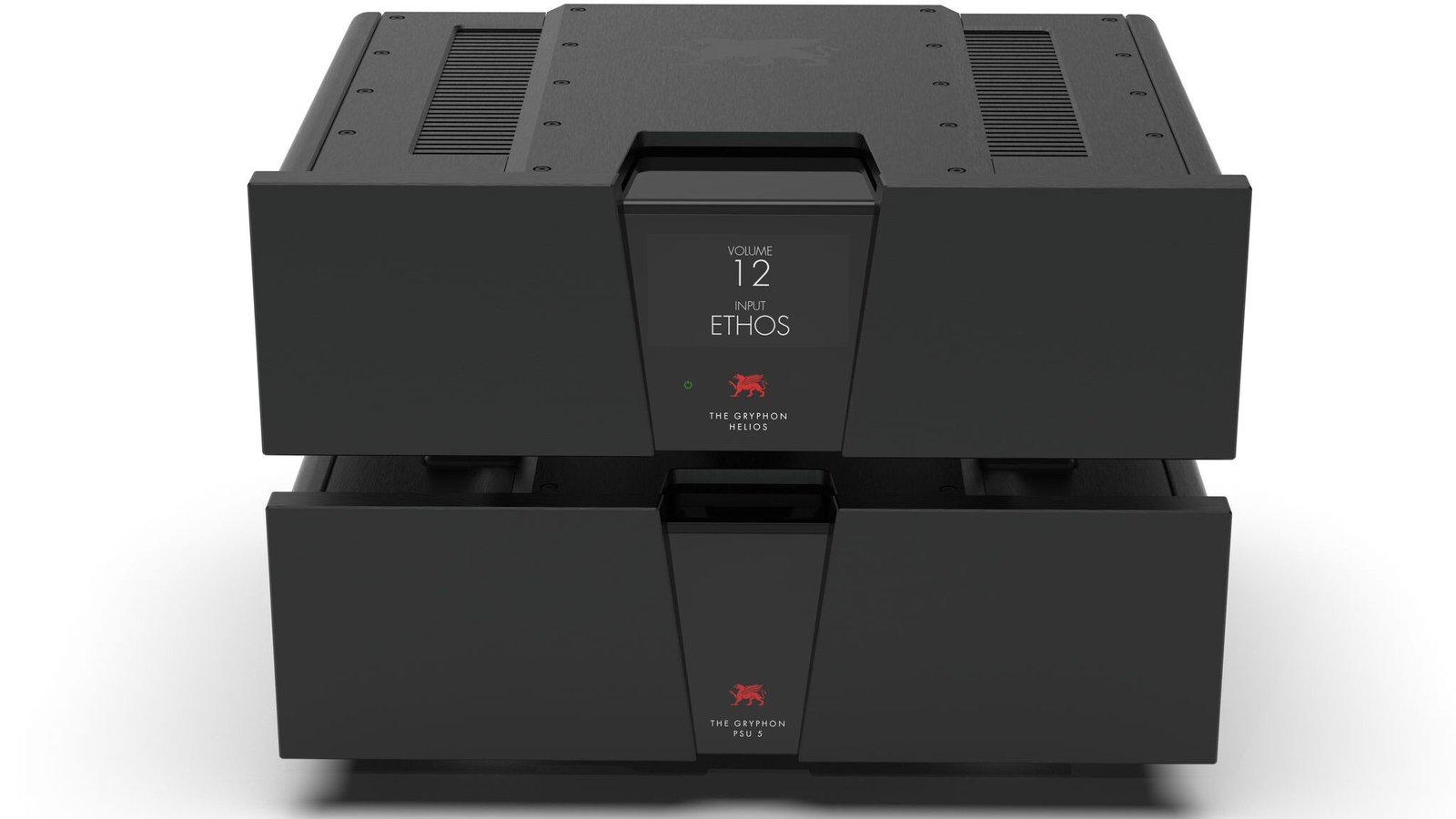
Gryphon Audio Designs launched the Helios today, the preamplifier that takes the place left by the Pandora — but not in the way you’d expect.
This isn’t a simple generational update. The Helios represents something more structural: a strategic repositioning of the Danish brand in a market segment that, until now, had some kind of a void.
Between the Pandora (discontinued) and the mythical Commander (absolute flagship), there was a missing proposal that combined technical ambition with real versatility. The Helios fills that space — and does so with three calculated moves.
1. Controlled democratization (but still €38,600 for the complete system)?
The price positions the Helios exactly where Gryphon wanted it: below the Commander, but far from “accessible” in absolute terms.
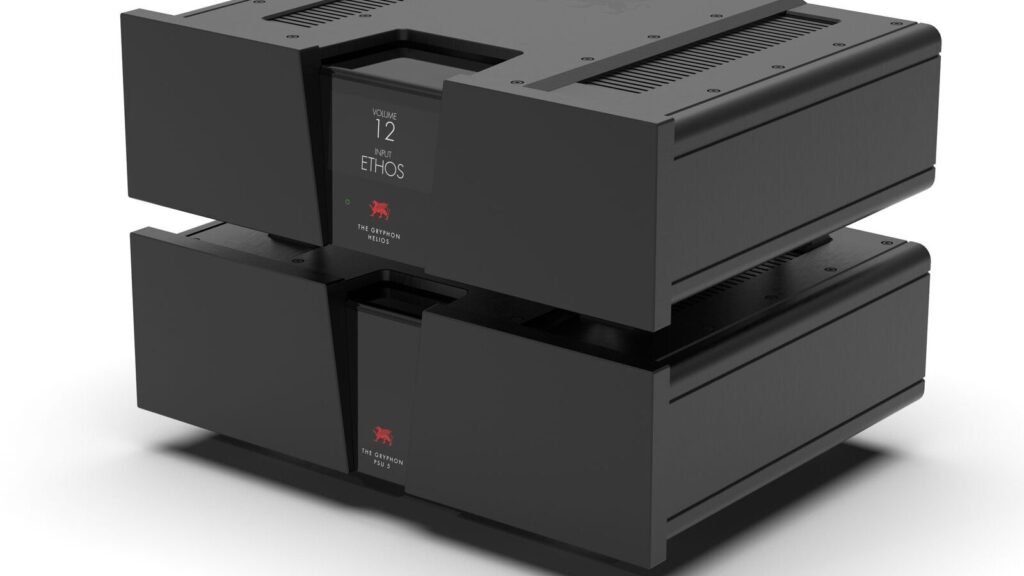
€22,800 for the preamplifier + €15,800 for the PSU 5 Dual Mono places the complete system at €38,600 (European pricing; in the US, $29,800 + $20,800 = $50,600).
For context: the Pandora cost significantly less at its launch. The Helios isn’t democratizing access to Gryphon — it’s raising the entry point for the brand’s reference segment.
This isn’t criticism. It’s strategy.
In a market where genuine high-end increasingly concentrates in the upper segments, Gryphon is adjusting its axis upward — maintaining range coherence while redefining where “accessible top tier” begins.
2. Modularity as future vision (not just a sales argument)
Here’s the Helios’s smartest move: two rear slots for optional modules.
Can be installed (at purchase or later):
- DAC3 Digital Module
- PS3 Phono Module
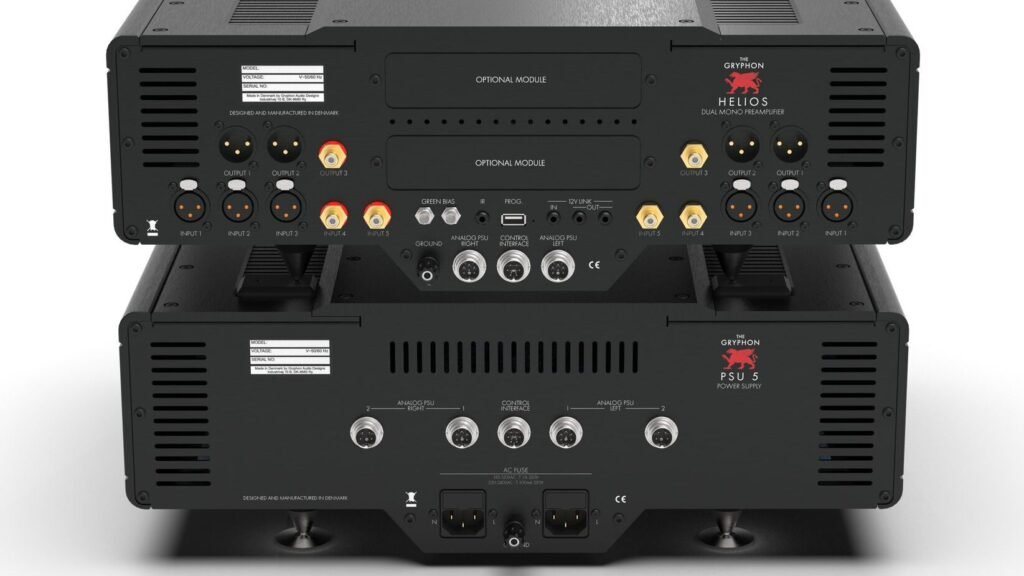
In a segment where signal purity is almost a religion, modularity is usually viewed with suspicion. Gryphon sidesteps this by not forcing definitive choices at purchase.
You buy a pure preamp. Later, if you want to integrate DAC or phono without adding external chassis, you have that option.
It’s rare in this segment. And reveals long-term vision.
The Helios isn’t a closed object. It’s a platform.
This changes the user’s relationship with the equipment — from “final product” to “evolutionary system.”
3. New visual language = cycle change (and this isn’t cosmetic)
Flemming Rasmussen, Gryphon’s founder, has always designed his own equipment. The result: a visual identity recognizable from meters away.
The Helios marks the first significant aesthetic change in a decade.
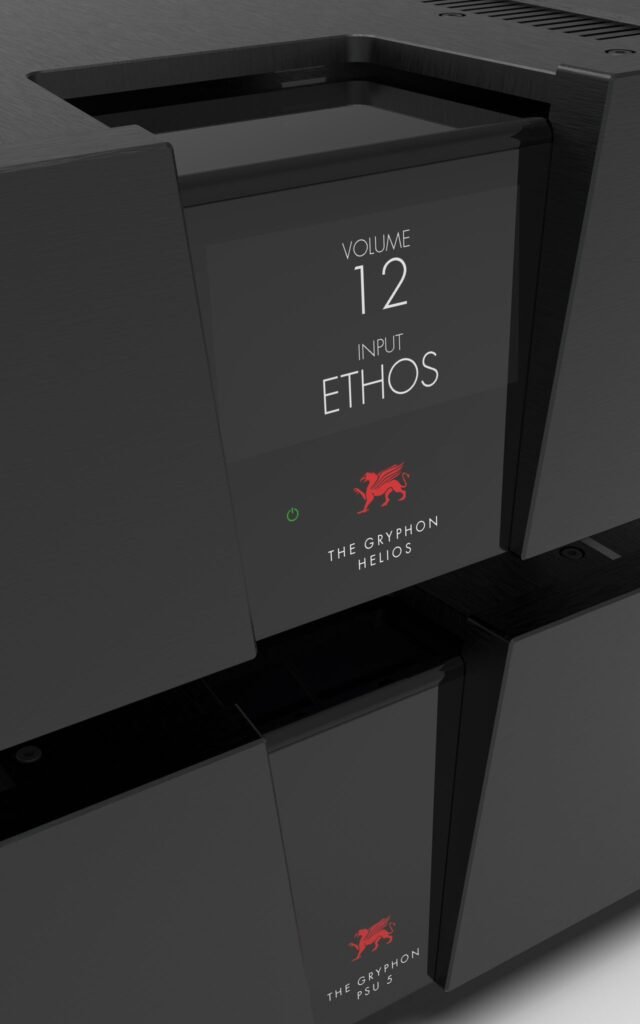
The “Nordic Noir” language remains (anodized aluminum, 4mm tempered glass, dark finishes), but there’s clear evolution: lines inspired by a waterfall, organic fluidity, abandonment of pure rigidity.
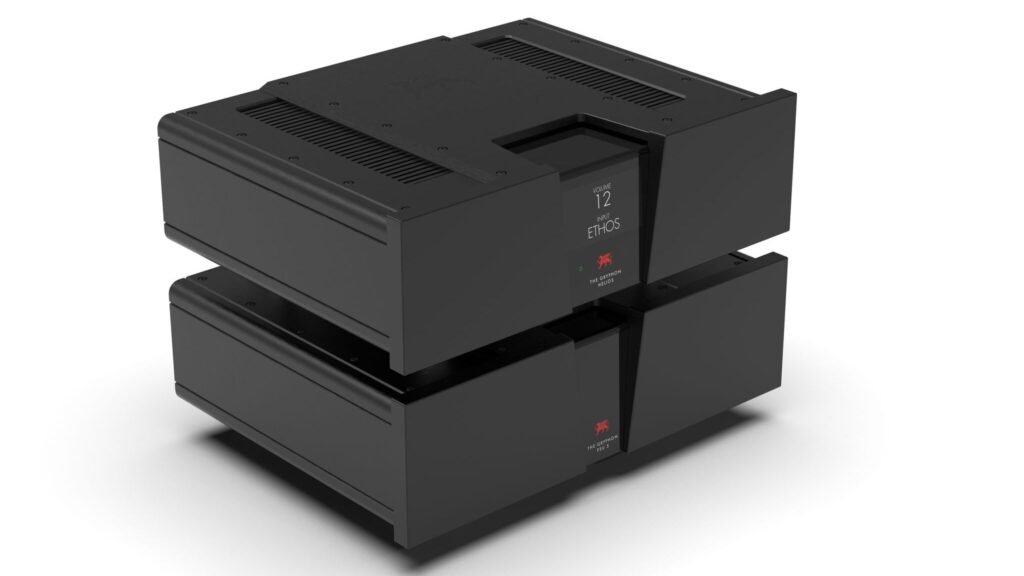
The most subtle detail? The inverted triangle — Gryphon’s visual mark present in the Essence, Apex, Commander, and Diablo 333 — only becomes visible when the preamp is stacked atop the PSU 5.
It’s not a random detail.
It’s an internal code. A signal for those who know the brand.
When a company like Gryphon changes its design language, it’s not just refreshing the catalog. It’s signaling an era change.
What changed technically (and what stayed)
The Helios inherits the dual mono in two chassis topology from the Pandora, but refines practically everything else:
Improvements over Pandora:
- New dual JFET design in the input buffer (Class A, single-ended)—now with only two transistors and one resistor in the signal path
- Volume circuit with 85 steps (relay + Vishay MELF SMD resistors)—impedance reduced to half versus Pandora, increasing bandwidth
- Dedicated single-ended output (proprietary Gryphon RCA)—the Pandora didn’t have one
- Single-ended input stage developed for the Commander (inherited by the Helios)
- Custom toroidal transformers (one per channel) instead of Pandora’s dual C-cores—lower magnetic radiation, allows direct stacking on PSU 5
What remains (by principle):
- Zero global negative feedback
- WIMA capacitors (polypropylene) for local decoupling
- Linear voltage regulators (Texas Instruments)
- CNC-machined aluminum structure
- Proprietary Gryphon spikes for resonance control
New functionalities:
- Home Theater Bypass (XLR + RCA)
- Individually adjustable gain per input
- Custom input naming
- 4.3″ touchscreen integrated in front glass panel
What this means, in practice
The Helios doesn’t replace the Pandora on a “same but better” basis.
It redefines what a Gryphon reference preamp is in 2026.
Three structural differences versus its predecessor:
- More versatile—modularity opens doors the Pandora kept closed
- More expensive—price repositioning is deliberate, not accidental
- More integrated—HT Bypass, A/V compatibility, input naming… this isn’t for purists isolated in stereo systems. It’s for complex, multi-source systems where the Helios functions as command center.
Gryphon is anticipating a market where even reference audiophiles don’t live on vinyl and CD alone. Streaming, A/V, multiroom—all must coexist. And the Helios was designed for that.
Conclusion
The Gryphon Helios isn’t just a product. It’s a strategic move.
Gryphon Audio Designs is repositioning itself for a high-end market where:
- Prices rise (and the audience that matters follows)
- Versatility stopped being the enemy of purity
- Aesthetics signal era change, not just catalog refresh
This isn’t “just another launch.”
This is the beginning of a new cycle.
And that, in the context of a brand with 40 years of history and crystallized identity, is far more relevant than the technical specifications suggest.
Gryphon Helios
Dual mono preamplifier, Class A, zero feedback
MSRP: €22,800 (preamp) + €15,800 (PSU 5)
Availability: immediate
Pingback: Novo Pré-amp Gryphon Helios: o reposicionamento que a marca precisava? - MoustachesToys | High-End Audio Reviews & Experiences