
What Hi-Res Audio Streaming Looks Like When It Actually Pays Artists
When a streaming platform stops talking about music and starts talking about money
There is a move that companies rarely make: stepping out from behind the product and exposing themselves as an economic system. Not in investor reports. Not in carefully worded press releases. In audited figures, published voluntarily, in an industry where opacity has long been treated as a competitive advantage.
Qobuz has just done exactly that. The gesture deserves attention. The narrative, a degree of scrutiny.
The numbers: hi-res audio growth, ARPU, and artist remuneration
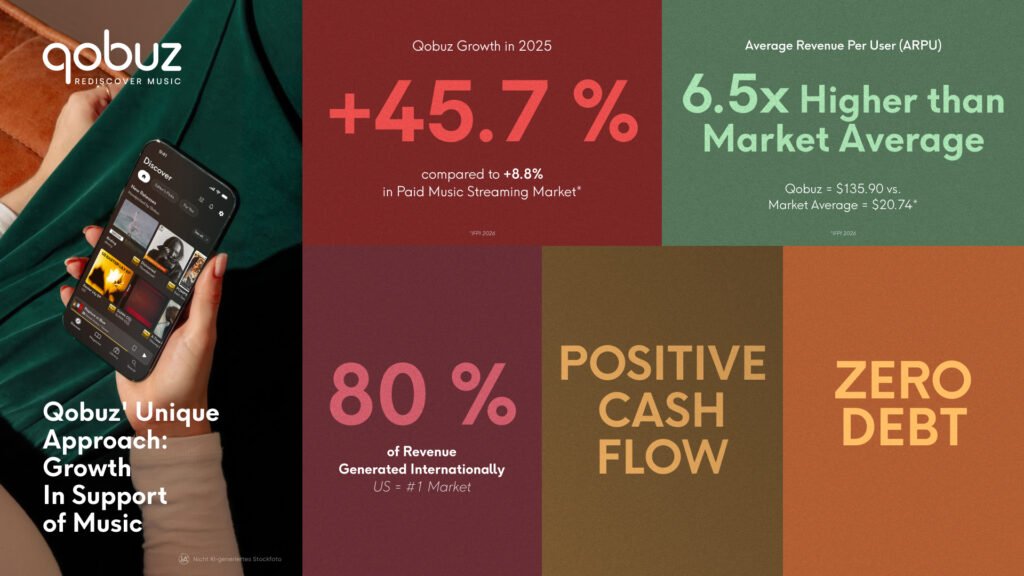
For the first time since its founding in 2007, the French platform has published financial and operational metrics with a level of detail unusual for the sector: 45.7% revenue growth in 2025, in a paid streaming market growing at 8.8%. Positive free cash flow. Zero financial debt. EBITDA break-even reached. Positive net income projected by March 2027. 1.2 million monthly active users, with 80% of revenue generated outside France — the United States as its largest market.
Two further metrics stand out, precisely because they remain almost taboo elsewhere in the industry: an ARPU of $135.90 per year — more than six times the market average — and, independently audited for fiscal year 2024, an average of $18.73 paid per 1,000 streams to labels and publishers. The first time any streaming platform has done this publicly.
Human curation and music without algorithms: a structural choice
The most revealing figure is not the growth rate. It is the architecture that sustains it — and the choices that define it.
Qobuz operates without a free tier, without advertising, with an entirely lossless and hi-res audio catalogue, and with declared human curation. In February 2026, it formalised this position through its own AI Charter: 100% human editorial selection, active exclusion of AI-generated content, and a proprietary detection system. In a sector quietly accelerating towards automation and synthetic content, music without algorithms is not simply a value proposition — it is a commercially risky declaration of intent.
High-resolution audio as a business model: niche, margin, and what the giants are not doing
In a market dominated by Spotify (volume), Apple Music (vertical integration), and Amazon (closed ecosystem), Qobuz has chosen margin over scale. Fewer users, more committed. Less noise, greater economic density per play. It is a thesis that runs almost counter-intuitively to two decades of digital technology logic: fewer can mean more sustainable, if the right listener is willing to pay for the higher quality audio experience the major platforms have never prioritised.
There is, however, a side to this narrative that should not go unexamined. These figures are self-reported, and the communication — however transparent it presents itself — also serves the interests of the company publishing it. The success of a niche model does not invalidate the dominance of the giants, nor does it resolve the structural questions around artist remuneration that the wider industry continues to avoid. It demonstrates that viable spaces exist within the ecosystem. Not that the ecosystem is fair.
What this means: streaming is not a model, it is a spectrum
What Qobuz is really demonstrating is not that it has grown. It is that hi-res audio streaming is not a single model — it is a spectrum. And that at one end of that spectrum, where each user is worth more than six times the market average, human curation and independence can still be a competitive advantage.
The question that remains is not how many users are enough. It is what the industry is prepared to do with this information — now that someone has finally decided to make it public.
Pingback: Qobuz abre os livros - MoustachesToys | High-End Audio Reviews & Experiences