
During Goldmund’s showcase to the Iberian market, in Portugal, the Reference Ultime Two occupied the main room at Ultimate Audio. It was there, between tracks, standing in front of the speakers, that I got a few minutes with Christophe Savioz, of Stenheim, to find out what sits behind a speaker with this kind of ambition.
Watch the full interview in the video at the end of this article.
From Alumine to Reference: same foundation, a step further
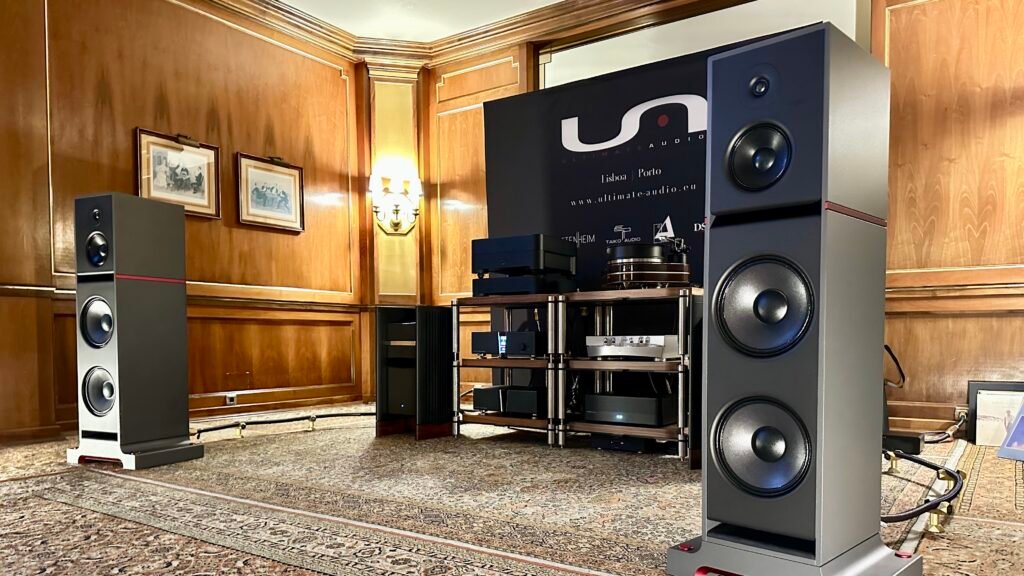
The Ultime Two is the entry point into the Reference Line, a step beyond the Alumine series Stenheim started with. I asked Christophe what actually changes from one line to the other.
His answer ruled out any idea of reinvention: aluminium chassis, high-efficiency transducers, a sophisticated crossover — the foundation stays the same. What changes is scale. Designed with bigger rooms in mind, more bass extension, more stage, more impact. “That is what it brings more,” he summed up.
Paper against diamond?
One question I’d been wanting to ask: why does Stenheim keep using coated paper-based diaphragms and silk-dome tweeters, when so much of the high-end world is chasing diamond, ceramic, or beryllium?
Christophe didn’t hesitate. The key, he said, is efficiency — and paper, an organic material, is what delivers it, alongside a sound he describes as natural. There’s no lab somewhere testing exotic materials in search of something better: “It is what we feel is what brings the most natural. It works.” No intention to change.
What you don’t see
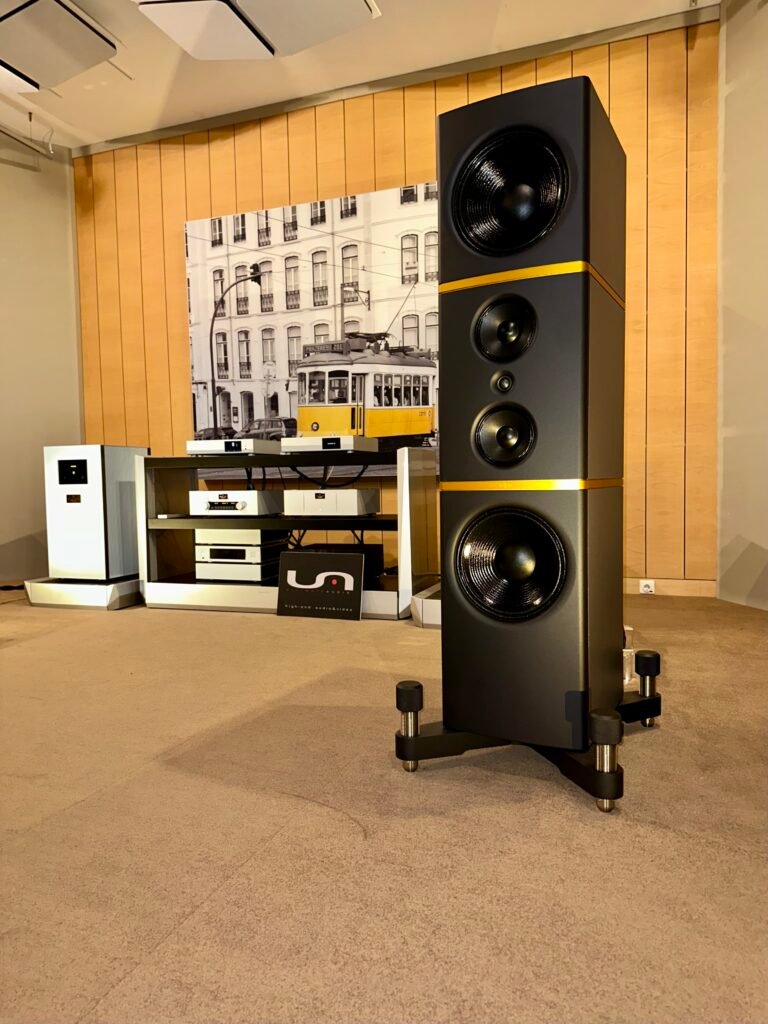
The massive aluminium cabinets, with the symmetrical D’Appolito layout, are the Reference line’s visual signature — but Christophe insists the intent isn’t to impress. Aluminium is inert; any resonance is damped; the goal is the most colourless sound possible. “We want to reproduce what has been recorded,” he said, almost as if it were obvious.
The more interesting detail, though, stays hidden: each transducer sits in its own isolated chamber inside the speaker, with no interference between them. “I wish sometimes we can open to show it to you,” Christophe said, almost wishing he could crack the speaker open right there. “We don’t see it, but we can hear it.”
Goldmund and Stenheim: more than neighbours
The link between the two brands isn’t just commercial convenience. Stenheim was founded by engineers who had come from Goldmund, before the company was bought by Jean-Pascal Panchard — impressed, according to Christophe, by a sound that matched his own vision exactly. He’s the one who took the brand from the small Alumine all the way to the Reference Line and, higher still, to The Statement — “four big towers,” even bigger than the ones we were listening to in that room.
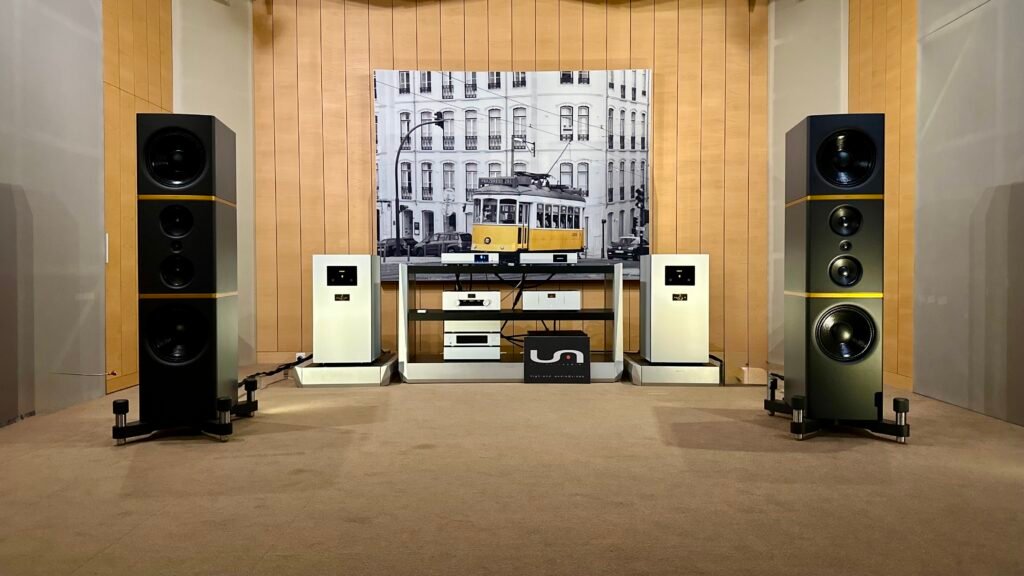
On pairing specifically with Goldmund electronics, Christophe was direct: he’d never heard this particular combination before, and the result impressed him personally. Two Swiss brands, he said, “we share a lot of value” — the same obsession with detail, the same pursuit of perfection. There was power, of course. But what stood out was something else: “More than power is control.”
“It was you”
Christophe genuinely tried to remember who’d said it first about the sound that day: “One of the person told me… told me it’s very honest.” I confirmed it was me. “Yeah, it’s you,” he laughed. “Now I am not the interviewer.” I gave it back. And he answered without hesitation:
“I think it’s really what we want to be. We want to be honest.”
It’s not a slogan prepared in advance. If anything, it’s the word that best describes what Stenheim is trying to do — even when the person who says it first isn’t the one being interviewed.
Close your eyes and see the orchestra
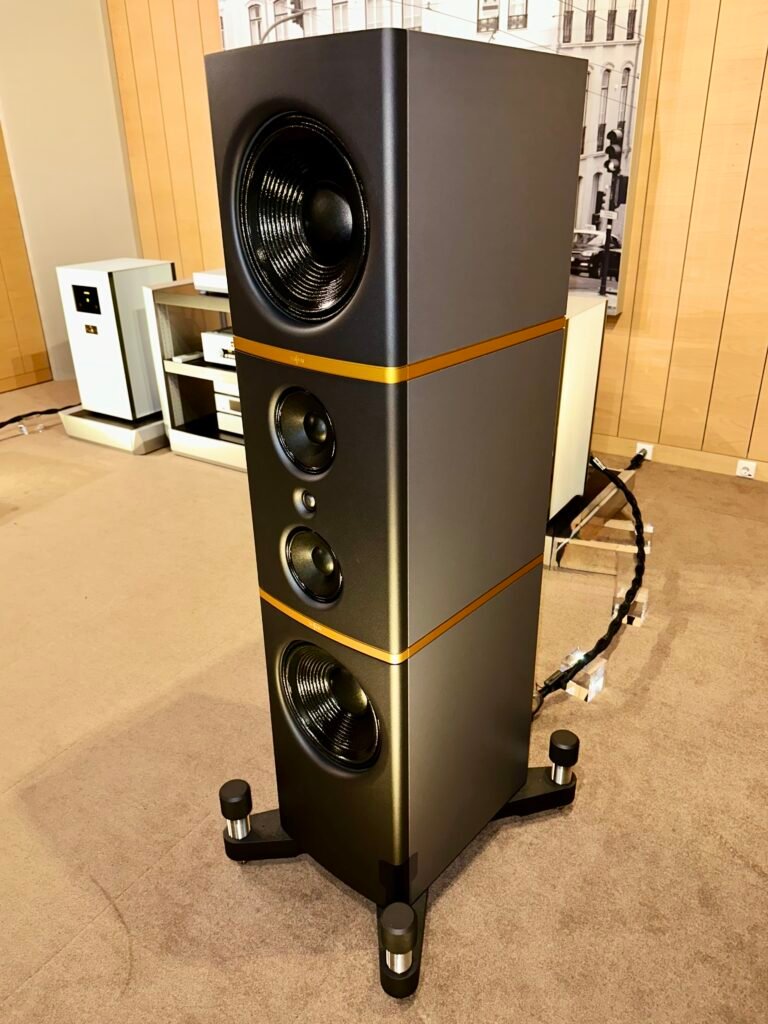
I asked about an idea that keeps coming up in the brand’s language — recreating the energy and atmosphere of a live concert. Is that something measurable, or purely subjective?
For Christophe, the answer starts with engineering, but ends in the listening room. The construction — an inert chassis, fast transducers, a carefully tuned crossover — is pure engineering. But what they’re chasing is sensory: someone closing their eyes and “seeing” the orchestra in front of them. That, he insists, only comes from hours of final tuning in the listening room — no spec sheet replaces that work.
Swiss precision, with an edge
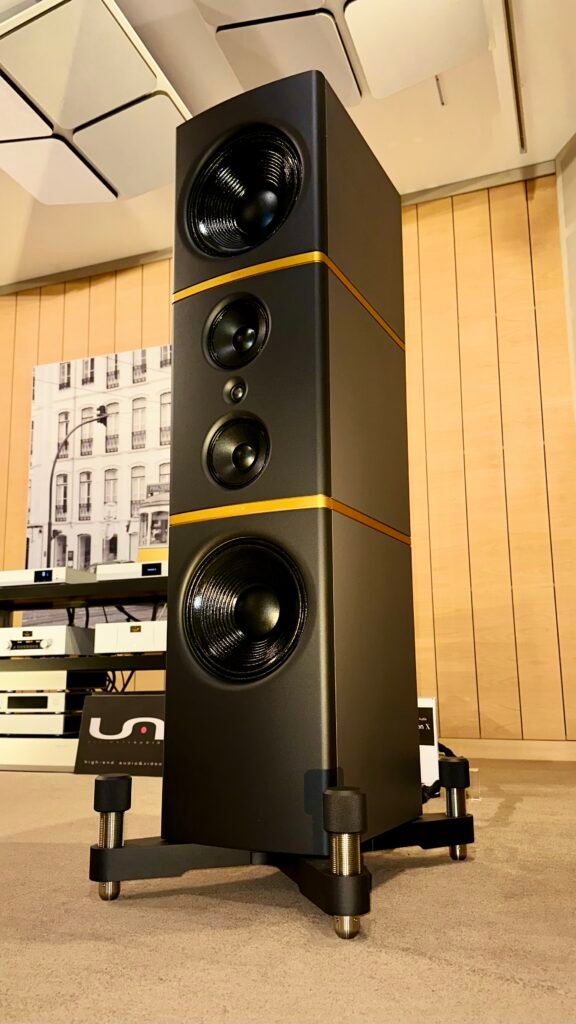
It’s a young brand compared to Goldmund, with whom it shared this showcase, yet already carrying strong international recognition — the Reference Ultime Two SX was named The Absolute Sound’s Cost-No-Object Loudspeaker of the Year for 2026. I asked how he’d describe Stenheim’s sonic identity against the Swiss tradition of neutrality and precision.
Precision is there, he said — that’s common across Swiss brands. But Stenheim’s signature, he stressed, is being immediate, dynamic, quick on the attack. It shows most clearly in the bass: detailed, precise, dynamic. That combination, not neutrality alone, is what he considers the true house sound.
The personal question
I saved the hardest question for last: if he had to pick a single recording to introduce someone to the Ultime Two for the first time, what would it be?
Christophe paused to think — the first question all day that left him hesitant. He landed on two tracks he’d heard that very afternoon: Pink Panther, for the range of tones and instruments, and a piece of Carmen (he believes by the Vienna Symphonic). And digging into personal taste, Miles Davis — “so many” possible options, but that one kept coming back. (This part of the answer didn’t make the final video edit.)
Before we said goodbye, Christophe made a point of thanking Ultimate Audio for the space — the local distributor’s attention to detail, he said, was as much a part of the experience as the speaker itself. It was right there, between the two Reference Ultime Two, that the conversation happened. It made sense: without that room, nothing he’d just described would have played out the same way.
MoustachesToys Meets Christophe Savioz – Stenheim
Interview conducted during Goldmund’s presentation to the Iberian market, with the Reference Ultime Two on demonstration in Ultimate Audio’s main room.

Pingback: "We want to be honest": Christophe Savioz explica a filosofia da Stenheim - MoustachesToys | High-End Audio Reviews & Experiences