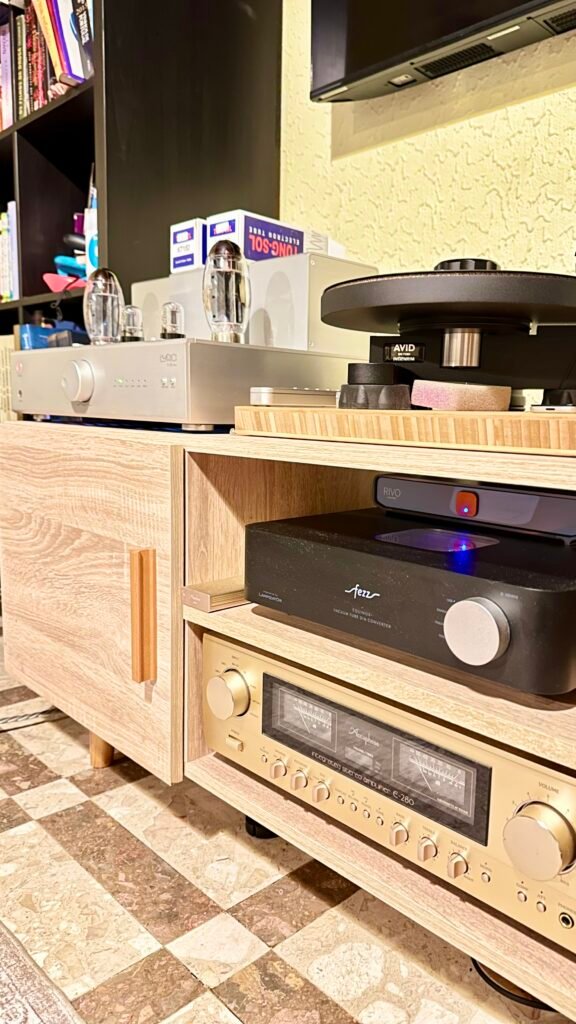
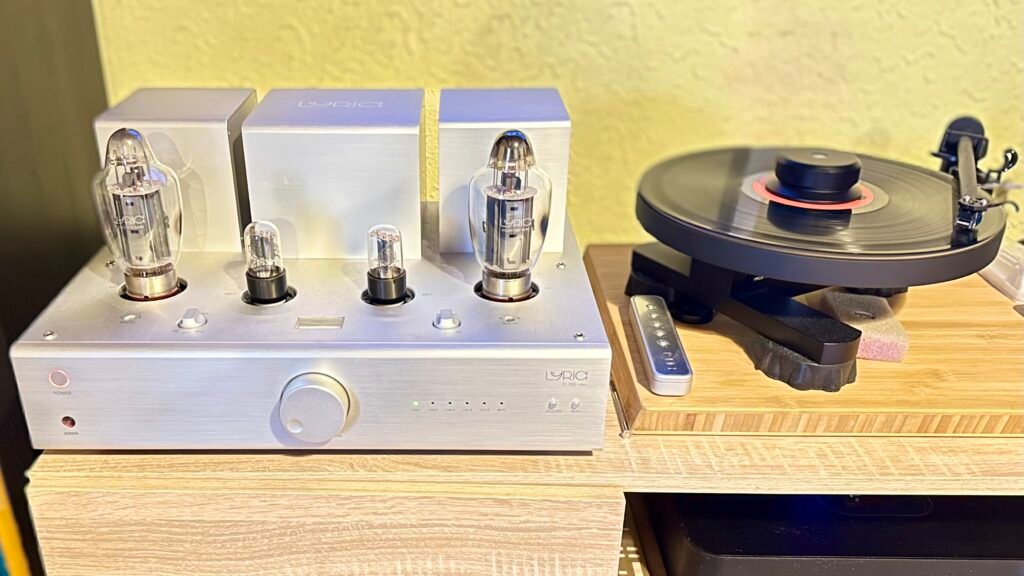
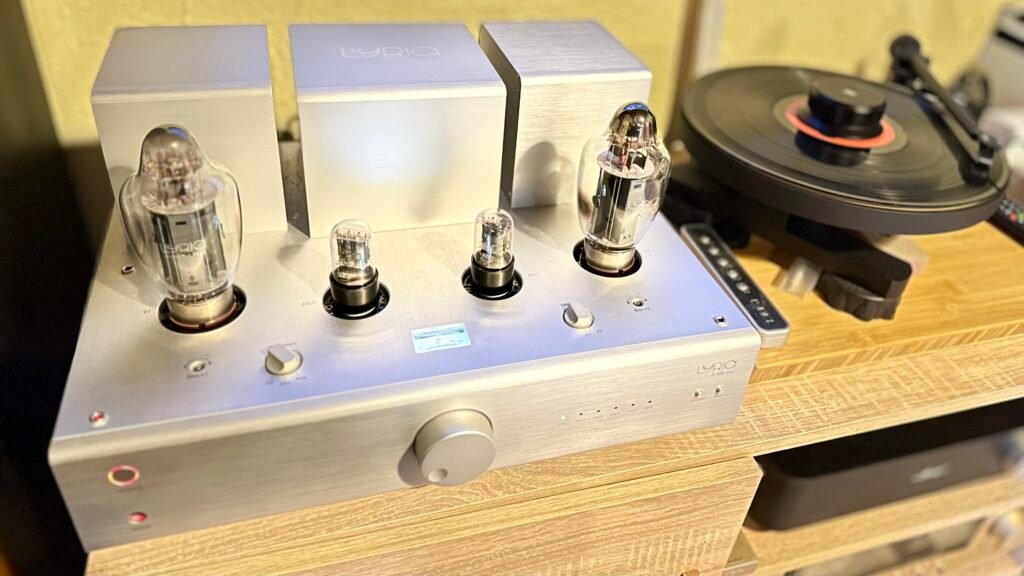
The Lyric Ti100 MkII is a single-ended, Class A, valve integrated amplifier — and, without any exaggeration, it was the emotional crutch that sealed my surrender to the Duevel Bella Luna point-source omnidirectional speakers. No disrespect to the speakers, of course. But here we have an amplifier with a rare gift: it does not merely reproduce music — it reshapes the listener. Upright audiophiles included. Occasional poets too.
After the first unit I had the pleasure of living with, kindly lent by a friend who undoubtedly deserves at least a statue in Ançã limestone — anything less would be historical ingratitude. A second unit arrived for this review courtesy of the brand’s Iberian representative. I spent a glorious month with this amplifier, taking the opportunity to do some tube rolling with three different matched valve pairs.
The Valvular Chameleon?
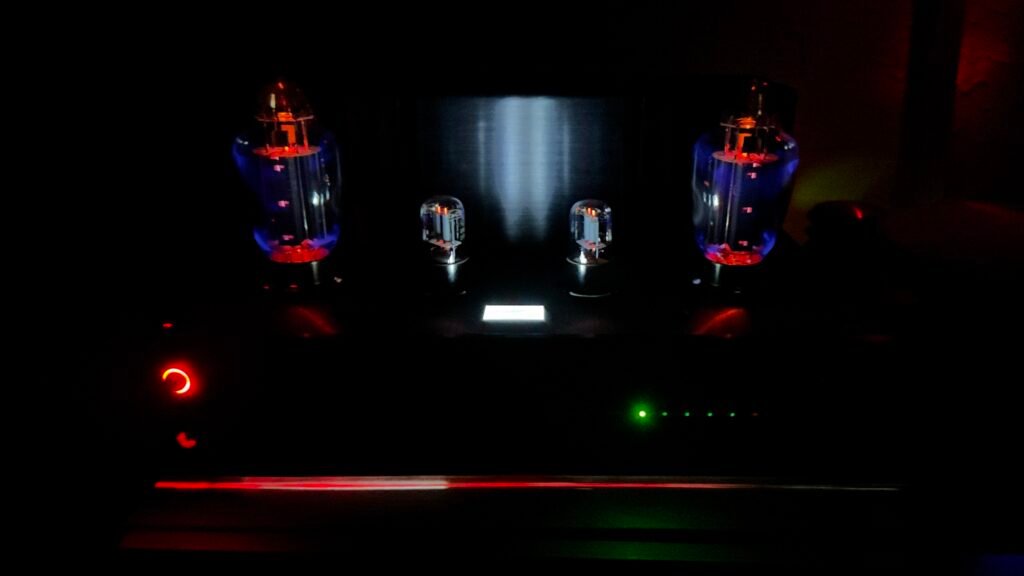
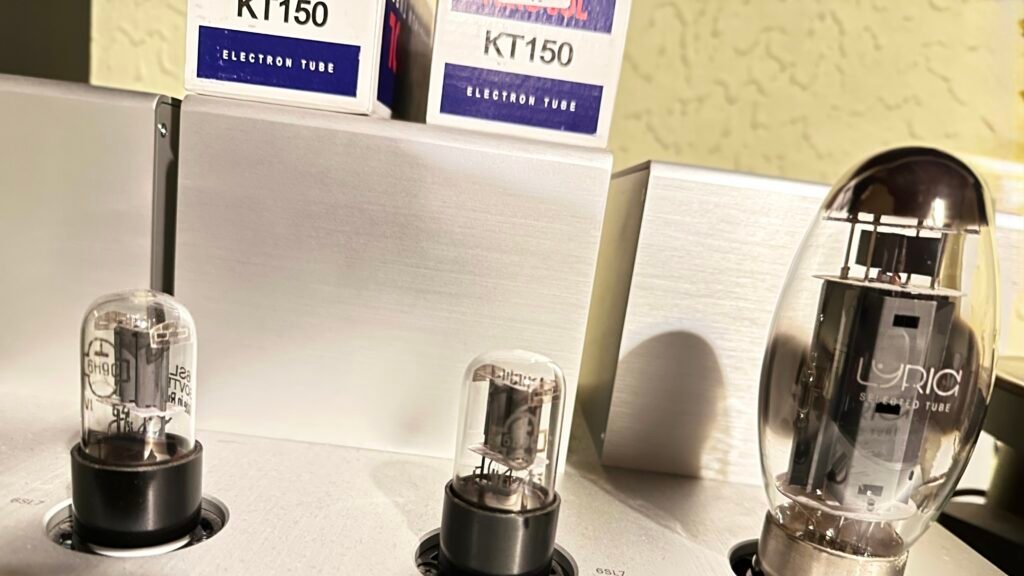
The first Ti100 MkII that accompanied me was fitted with KT170 valves. But here lies part of the magic of some valve amplifiers: the Ti100 accepts EL34, KT77, KT88, 6550, KT120, KT150, and KT170, offering a tuning range rarely seen in a contemporary integrated amplifier.
With manual bias adjustment (50 to 125 mA depending on the valves) and feedback selection (low, medium or high, at 4 or 8 ohms) on the back panel, it is possible to extract six distinct sonic signatures per valve pair. This is no marketing trick. It is a real, precise, musical tool.
Here lies the genius — and the danger — of the Ti100 MkII: more than nominal impedances or numbers on a spec sheet, it commands the record that is playing… and, yes, the mood. Some valves demand introspection. Others demand the stage. Others demand: “silence, we’re about to sing Fado!”
The Hairy Question
The initial experience with the KT170 and the Bella Luna was enlightening. But the inevitable question arose: how would the Ti100 MkII behave with more “down to Earth” speakers, like my Revival Atalante 3?
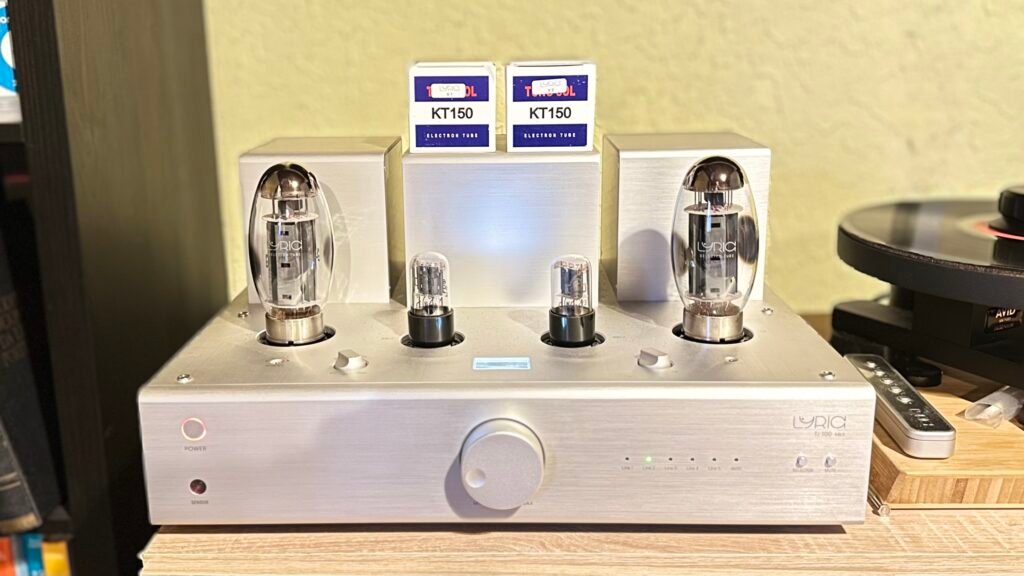
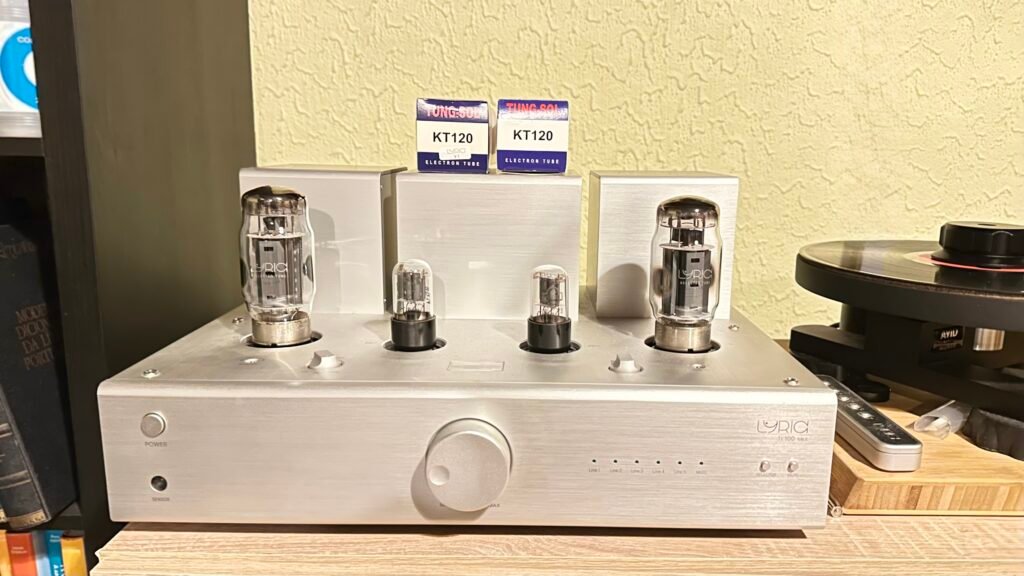
Challenge accepted. A second Ti100 MkII arrived at Moustache’s Tower — this time in silver, though colour hardly matters — accompanied by a complete set of matched KT120, KT150, and KT170. Ready. Tube rolling, properly. The narrative finally gained dramatic depth.
What the Ti100 Does Before We switch Valves
The Lyric Ti100 MkII presents a signature I would describe as neutral-organic: transparent, timbrally refined, and endowed with an authority that renders irrelevant the number “20” on the spec sheet, referring to Watts.
Yes, twenty Watts. But twenty single-ended, Class A, valve Watts — those that deliver current, control, and harmonic density continuously, not episodically. The transformers in this amplifier — by their weight — I suspect could drive a Second World War Panzerkampfwagen.
The result: the bass is full and tense. The midrange, dense and articulate. The treble, open, clean, and refined. The energy does not come from artificial brilliance or easy impact, but from real micro and macrodynamics, sustained.
Even with medium/low sensitivity speakers, like the Atalante 3, not ideal, at least on paper, for this type of amplifier — the control is exemplary: elastic bass, precise attack-braking, tight. Nothing collapses.
Character
The Lyric’s character is transparent, yet deliberately euphonic, in the best sense. It reveals texture, timbre, and micro-information with natural fluidity, without ever tipping into clinical or soulless analysis.
The macrodynamics are convincing, with orchestral attacks of real physical impact. The soundstage is truly volumetric: wide, deep, with stable imaging and sufficient silence for the music to breathe.
Voices emerge dense, expressive, unmistakably human. Instruments reveal materials and techniques with clarity: bow, reed, finger, breath. Everything is there — not as an effect, but as a natural consequence of well-conceived electronics and carefully chosen materials.
Tube Rolling — A Nine-Act Sonic Film

It is precisely because the Ti100 MkII has such a solid and coherent character that tube rolling becomes relevant: not to reinvent it, but to fine-tune it — to one’s taste, or for each occasion.
From this point, the engineer steps aside. The listener takes the seat.
Before going track by track, it is important to set the context: the differences between the valves tested — KT120, KT150, and KT170 — are not night and day. They’re there, clear and consistent, but occur within the same sonic identity. Put another way: the difference between the Lyric Ti100 MkII and my resident Accuphase E-280 — or the valve monoblocks that were simultaneously in my room — is considerably greater than the difference between these valves themselves.
Still, this exercise is crucial to understand how far the amplifier’s character can be tuned via tube rolling, adapting it not only to the system but also to personal taste and musical repertoire.
Soyeusement — Michel Godard
I started with Godard because this track tests everything at once: timbre, space, texture, and breathing.
With the KT170, the sound opens in all directions: extended, clean treble with air and excellent resolution. The soundstage gains scale and depth, taking on a three-dimensional, holographic character. Presentation is authoritative, confident, never forced.
The KT120 brings the music forward. The mass of sound becomes more fluid and direct, with denser bass and fuller mids. The treble recedes: smoother, less incisive. There is less separation and a very slight compression, yet a physicality almost archetypal preconceived image of single-ended sound. The soundstage is wide, though less profound.
The KT150 strikes a perfect balance: good treble extension, though less acute than in than the KT170; controlled bass; soundstage wide and deep — deeper than the KT120, less expansive than the KT170. The equilibrium between visceral impact and authority is particularly happy here.
If Soyeusement reveals character and spatiality, Stimela tests nerve, dynamics, and the ability to maintain cohesion when the music gains body and urgency.
Stimela (The Coal Train) — Hugh Masekela (Live)
Here, differences becomes clearer.
The KT150 offer the most complete reading: excellent instrumental separation, fast and controlled bass, trumpet with texture and brilliance without aggression. Micro and macrodynamics are well articulated. The effect is physical and emotional: we relax in pauses and lean forward as the band erupts.
The KT120 brings Masekela’s voice closer, almost frontal. Cymbals lose some resolution and air, gaining a slight grain. Instrumental interplay is more evident, though individual separation is superior in the other valves. Dynamics are lower, with subtle compression on complex passages. The added fluidity makes listening particularly enjoyable.
The KT170 sound majestic: firm, articulated bass, clean incisive trumpet, extended cymbals without grain and with exceptional resolution. The dynamics are explosive and absolutely loose, highlighting the amplifier’s power reserves. Soundstage is vast, three-dimensional, immersive. Fast and thrilling transients. Authoritative presentation in the best sense.
Toccata and Fugue — J. S. Bach
After the human pulse and stage warmth, it was time to test scale, authority, and absolute control.
With the KT170, the organ descends to cavernous, almost seismic depths without ever losing composure or definition.
The KT150 also descend very low, though with less apocalyptic drama. The scale remains impressive.
The KT120 maintain the solemnity and physical impact of this work. Separation and resolution are less evident than the other two, and the bass does not reach as deep, yet the solemn, corporeal character remains intact.
Sei de um Rio — Camané
In this recording, the narrative changes tone.
The KT120s shine with the organicity and fluidity of Camane’s voice. It’s here that we most easily approach the intimate experience of a live fado session.
The KT150s bring more attack, scale and resolution to the accompaniment, redistributing the protagonism. The voice gains greater micro-detail and nuance, making the moments of greatest emotional commitment evident. The gain in soundstage depth is particularly welcome.
The KT170 adds transients speed and impetuosity, but slightly sacrifices vocal organicity. In this track, the balance of the KT150 ultimately prevails.
Tosca, Act III — “E lucevan le stelle” (Puccini)

In the historic 1953 recording with Giuseppe Di Stefano and the Teatro alla Scala Orchestra under Victor de Sabata, the KT170 honour the scale and emotional charge of this work, projecting it with authority and impact.
The KT150 impress with their compromise: the full emotion of the performance and the entire orchestral scale are conveyed with overwhelming effect, without excess.
The KT120 provide a flatter soundstage and less dynamic range. The tenor’s voice gains, again, a slight added organic quality, yet at extremes begins to lag.
From the flesh and blood of this 1953 opera, I moved to Laurie Anderson.
Beautiful Pea Green Boat — Laurie Anderson
The KT120 sound muscular and direct. Bass descends with authority; the track’s dreamlike, intimate, nostalgic character is fully realised. Had I not heard the other valves, it would be easy to remain entirely satisfied.
The KT170 reveal everything: vocal nuance, subtle effects, attack and transients more present, dynamics more apparent. For those who wish to hear every detail, they are unbeatable.
The KT150 are the balance point: combining the KT120’s vocal magic and fluidity with the KT170’s openness, resolution, stage, and speed.
After introspection and dreamlike, it was inevitable to summon bodily presence to the room.
Since I’ve Been Loving You — Led Zeppelin
The KT150 are particularly competent in this raw, emotionally dense track. They maintain the nearly claustrophobic ambience of the recording, with control and musicality. An excellent compromise for mid-to-high level systems.
The KT170 bring more treble extension and a slight gain in scale, but the difference from the KT150 is marginal.
The KT120 re-emerge strongly: more fluidity and a more organic character make this listening not at all fatiguing and more engaging. For those not seeking to radiograph every recording, these may be the most rewarding for extended sessions.
If rock tests impact and fluidity, Shostakovich tests organisation, density, and the ability to handle complex sonic masses.
Allegretto poco moderato — Shostakovich (Boston Symphony / Andris Nelsons)
The KT120 present more fluidity and smoothness in the treble, enhancing overall musicality.
The KT150 place more orchestra in the room: greater openness, detail, separation, focus, and soundstage depth. Firmer bass, higher resolution, greater speed. Emotional engagement is slightly superior here.
The KT170 are in their element: detail, scale, vigour, speed, and abundant dynamics. Absolutely delightful.
After emotional tension and density, it was time to see if the amplifier still knew how to smile.
Tuxedo Junction — Kenichi Tsunoda Big Band
With the KT170, the ability to project an entire big band in a room under 25 m²/ 270 square feet is astonishing. Dynamics, speed, and transients are utterly captivating.
The KT120 offer greater smoothness and fluidity, ideal for more sensitive ears.
The KT150 present an interesting compromise between speed and organicity, but on this track the KT170 clearly win.
What About My Verdict?
Every track, every genre, every occasion calls for a different valve. Tube rolling in the Lyric Ti100 MkII is not a whim. It is a real tool for musical fine-tuning.
This amplifier does not tell you how to listen to music. It invites you to choose how you wish to experience it.
And it does so with 20 glorious, honest, and absolutely sufficient Watts. If anyone claims they are not enough, lend them the Ti100 for an afternoon. You will get it back with an apology.
Now, let me stay with Vicente Amigo and the KT150. No irony. No exaggeration. No reservations.
P.S. — At the time of writing, the brand importer has not yet requested the amplifier back. I am considering logistical options. Moving house is still seriously on the table.
Pingback: Tube Rolling com o Lyric Ti100 MkII (e já agora, a review ao amplificador) - MoustachesToys | High-End Audio Reviews & Experiences